

Information





Start using NetBird at netbird.io
See Documentation
Join our Slack channel or our Community forum
New: NetBird terraform provider
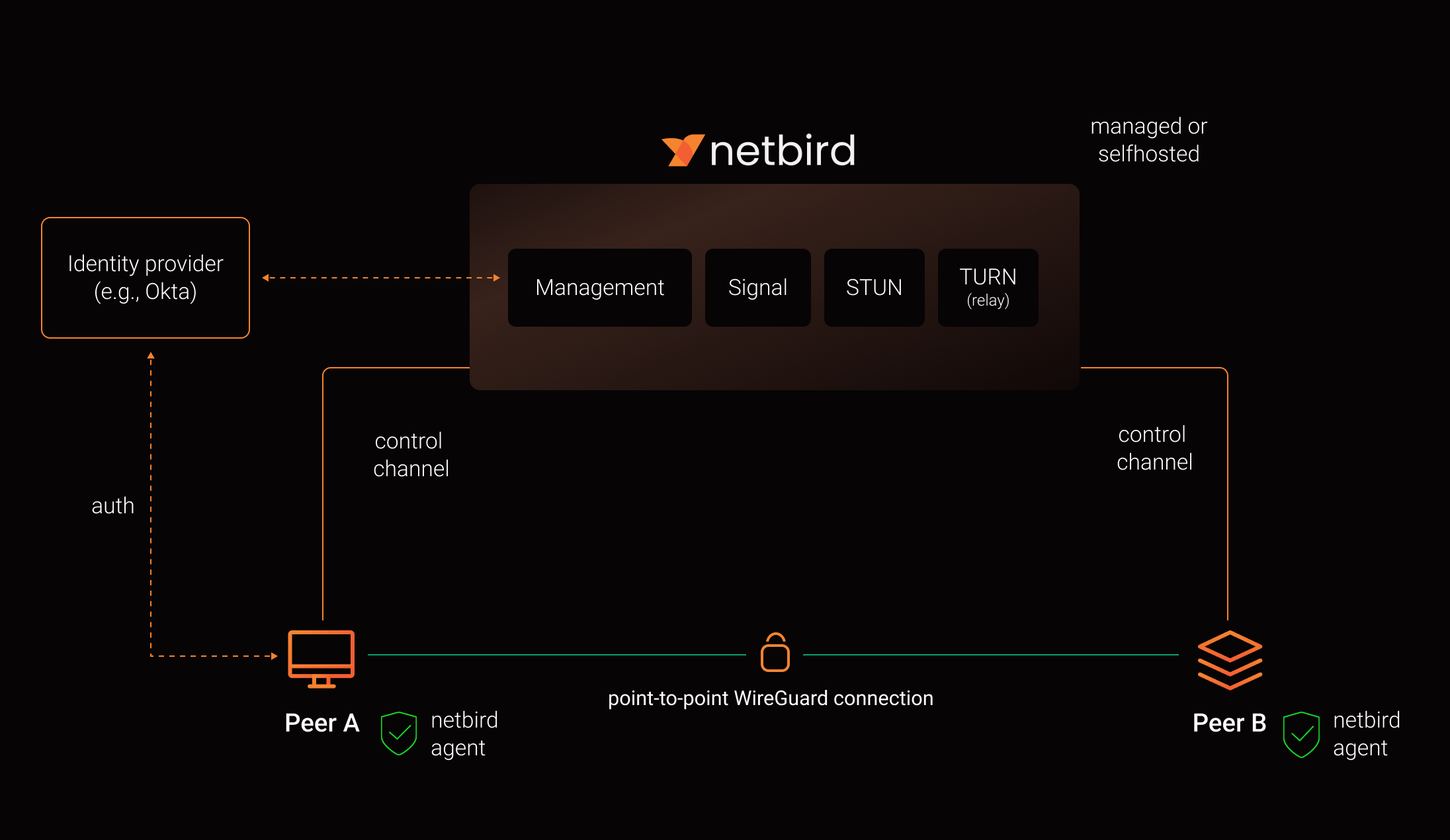
**NetBird combines a configuration-free peer-to-peer private network and a centralized access control system in a single platform, making it easy to create secure private networks for your organization or home.** **Connect.** NetBird creates a WireGuard-based overlay network that automatically connects your machines over an encrypted tunnel, leaving behind the hassle of opening ports, complex firewall rules, VPN gateways, and so forth. **Secure.** NetBird enables secure remote access by applying granular access policies while allowing you to manage them intuitively from a single place. Works universally on any infrastructure. ### Open Source Network Security in a Single Platform https://github.com/user-attachments/assets/10cec749-bb56-4ab3-97af-4e38850108d2 ### NetBird on Lawrence Systems (Video) [](https://www.youtube.com/watch?v=Kwrff6h0rEw) ### Key features | Connectivity | Management | Security | Automation| Platforms | |----|----|----|----|----| |
- - \[x] Kernel WireGuard
- - \[x] [Admin Web UI](https://github.com/netbirdio/dashboard)
- - \[x] [SSO & MFA support](https://docs.netbird.io/how-to/installation#running-net-bird-with-sso-login)
- - \[x] [Public API](https://docs.netbird.io/api)
- - \[x] Linux
- - \[x] Peer-to-peer connections
- - \[x] Auto peer discovery and configuration |
- - \[x] [Access control - groups & rules](https://docs.netbird.io/how-to/manage-network-access) |
- - \[x] [Setup keys for bulk network provisioning](https://docs.netbird.io/how-to/register-machines-using-setup-keys) |
- - \[x] Mac | |
- - \[x] Connection relay fallback |
- - \[x] [IdP integrations](https://docs.netbird.io/selfhosted/identity-providers) |
- - \[x] [Activity logging](https://docs.netbird.io/how-to/audit-events-logging) |
- - \[x] [Self-hosting quickstart script](https://docs.netbird.io/selfhosted/selfhosted-quickstart) |
- - \[x] Windows | |
- - \[x] [Routes to external networks](https://docs.netbird.io/how-to/routing-traffic-to-private-networks) |
- - \[x] [Private DNS](https://docs.netbird.io/how-to/manage-dns-in-your-network) |
- - \[x] [Device posture checks](https://docs.netbird.io/how-to/manage-posture-checks) |
- - \[x] IdP groups sync with JWT |
- - \[x] Android | |
- - \[x] NAT traversal with BPF |
- - \[x] [Multiuser support](https://docs.netbird.io/how-to/add-users-to-your-network) |
- - \[x] Peer-to-peer encryption ||
- - \[x] iOS | |||
- - \[x] [Quantum-resistance with Rosenpass](https://netbird.io/knowledge-hub/the-first-quantum-resistant-mesh-vpn) ||
- - \[x] OpenWRT | |||
- - \[x] [Periodic re-authentication](https://docs.netbird.io/how-to/enforce-periodic-user-authentication) ||
- - \[x] [Serverless](https://docs.netbird.io/how-to/netbird-on-faas) | |||||
- - \[x] Docker | ### Quickstart with NetBird Cloud - Download and install NetBird at [https://app.netbird.io/install](https://app.netbird.io/install) - Follow the steps to sign-up with Google, Microsoft, GitHub or your email address. - Check NetBird [admin UI](https://app.netbird.io/). - Add more machines. ### Quickstart with self-hosted NetBird > This is the quickest way to try self-hosted NetBird. It should take around 5 minutes to get started if you already have a public domain and a VM. Follow the [Advanced guide with a custom identity provider](https://docs.netbird.io/selfhosted/selfhosted-guide#advanced-guide-with-a-custom-identity-provider) for installations with different IDPs. **Infrastructure requirements:** - A Linux VM with at least **1CPU** and **2GB** of memory. - The VM should be publicly accessible on TCP ports **80** and **443** and UDP ports: **3478**, **49152-65535**. - **Public domain** name pointing to the VM. **Software requirements:** - Docker installed on the VM with the docker-compose plugin ([Docker installation guide](https://docs.docker.com/engine/install/)) or docker with docker-compose in version 2 or higher. - [jq](https://jqlang.github.io/jq/) installed. In most distributions Usually available in the official repositories and can be installed with \`sudo apt install jq\` or \`sudo yum install jq\` - [curl](https://curl.se/) installed. Usually available in the official repositories and can be installed with \`sudo apt install curl\` or \`sudo yum install curl\` **Steps** - Download and run the installation script: \`\`\`bash export NETBIRD_DOMAIN=netbird.example.com; curl -fsSL https://github.com/netbirdio/netbird/releases/latest/download/getting-started-with-zitadel.sh | bash \`\`\` - Once finished, you can manage the resources via \`docker-compose\` ### A bit on NetBird internals - Every machine in the network runs [NetBird Agent (or Client)](client/) that manages WireGuard. - Every agent connects to [Management Service](management/) that holds network state, manages peer IPs, and distributes network updates to agents (peers). - NetBird agent uses WebRTC ICE implemented in [pion/ice library](https://github.com/pion/ice) to discover connection candidates when establishing a peer-to-peer connection between machines. - Connection candidates are discovered with the help of [STUN](https://en.wikipedia.org/wiki/STUN) servers. - Agents negotiate a connection through [Signal Service](signal/) passing p2p encrypted messages with candidates. - Sometimes the NAT traversal is unsuccessful due to strict NATs (e.g. mobile carrier-grade NAT) and a p2p connection isn't possible. When this occurs the system falls back to a relay server called [TURN](https://en.wikipedia.org/wiki/Traversal_Using_Relays_around_NAT), and a secure WireGuard tunnel is established via the TURN server. [Coturn](https://github.com/coturn/coturn) is the one that has been successfully used for STUN and TURN in NetBird setups.